

FOB (Free on Board) and Ex Work are 2 common legal terms used in global trade law, these sets of business terms are otherwise known as Incoterms.
Established in 1936 and revised every ten years by the International Chamber of Commerce (ICC), Incoterms are used worldwide in international and domestic contracts in the sale and transfer of goods by governments, local authorities and law practitioners worldwide. They make the process easier and remove uncertainties such as the different interpretation of rules in various countries. In this article, we will discuss the meaning of these two Incoterms and assess their benefits and responsibilities.
Lets start off with one of the most widely used terms “FOB” – Free On Board.
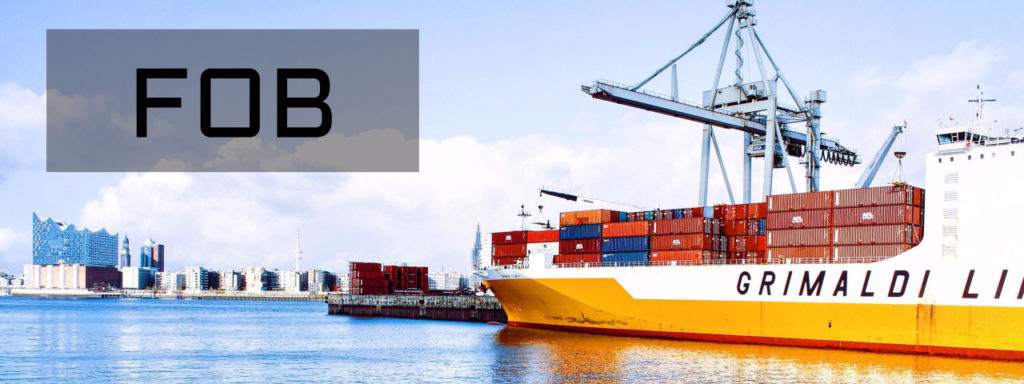
FOB: The seller delivers the goods up to the point of transfer.
Usually a seaport or an airport of buyer’s choice. In simple terms – it means the seller is responsible for all cost associated with the goods and logistics until they land on a ship or airplane for delivery. This can include
• Delivery cost from seller’s warehouse to port (when it’s a container or multiple container load, this can be a huge cost)
• Any insurance obligations – If a truck crashes and the goods are totally destroyed, the obligation is with the seller and not buyer
• Documents required to clear customs – Some export countries require documentation before the goods can go on a ship or airplane, the seller would be responsible for preparation of these documents
• 3rd party inspection is still recommended even if your supplier is offering FOB terms, as quality assurance has nothing to do with the payment terms.
FOB is an Incoterm specifying the point where obligations, costs and risks associated with the delivery of goods switch from the vendor to the buyer. According to the Incoterms 2010 standard as published by the ICC, FOB is used solely for non-containerized loads or goods shipped via inland waterway transport. It is important to remember, however, that ownership of goods is a very different issue, which is specified by the bill of lading.
FOB is always used with the name of loading port. “FOB port” specifies that the responsibility for loading and transportation costs up to the shipment port belongs to the seller, while the buyer pays the costs of marine freight (cargo) transport, insurance, unpacking and the transportation from the harbor from which the vendor sends the goods to the end-destination. Risks such as loss or damage to the goods are passed from the vendor to the buyer the moment when the specified goods are on board the vessel. However, in all FOB agreements, the seller is obligated to deliver the merchandise at a destination agreed by the buyer. An example would be a Shenzhen factory quoting terms “FOB Shenzhen” or “FOB Yantian” (Yantian is a more specific seaport within Shenzhen)
Special case worth noting: North American FOB.
According to the Uniform Commercial Code, for internal shipments within the U.S. and Canada, FOB carries a slightly different meaning. We might encounter “FOB origin”, meaning that the transfer occurs immediately as the merchandise is loaded on the vessel (at the seller’s shipping dock) or “FOB destination”, meaning that the transfer takes place when the commodities are unloaded from the vessel, at destination (the vendor is the one paying freight costs and any liabilities during transport). In order to prevent confusion with the exclusively domestic usage of “FOB” in North America, it is advised for international shipments to explicitly specify the use of Incoterms, as well as the edition used such as “FOB Amsterdam (Incoterms 2000)”.
The other widely used terms for sales contracts is Ex Work

For Ex Works, the seller makes no transportation arrangements. In simple terms – Seller is responsible for supplying the goods and obligations are over once the order leaves the doors of their premises.
• Buyer needs to arrange transportation from seller’s premise to destination. Seller only needs to see the goods safely out their own door
• Buyer is responsible for all risk associated with goods once it leaves the seller’s premises
• Buyer will need to prepare any document required for export in local country
• If the delivery transportation of cargo encounters an accident on its way to the airport or seaport, the responsibility would be the buyer. Therefore buyer is recommended to purchase insurance.
EX WORK (EXW – named place of delivery) is another Incoterm, describing a transaction in which the seller ensures that the goods are available at his own premises or at another specified place. According to the Farlex Financial Dictionary, the maximum obligation is placed on the buyer (including transportation costs), while the seller has minimum obligation (such as packaging the goods and making them available at a location). It is very commonly used by companies making an initial quotation for the sale of goods, as it usually doesn’t include any additional costs.
The responsibility for export documentation belongs exclusively to the buyer.
According to Investopedia, EXW agreements can be problematic in terms of export documentation and taxes, both for the seller and the buyer. The seller is obligated to help the buyer with the paperwork needed for shipping and customs and also to make sure that such documents are accurate in describing the contents of the packages that are to be shipped, but all costs and risks are on the part of the buyer. In the same time, the buyer is not obligated to provide a proof of export to the seller and this might leave the seller liable to pay a full sales tax (equivalent to the one paid if the goods are sold to a domestic customer). These terms need to be carefully discussed and written on sales contract to avoid any disputes in the future.
Trade terms used in various countries might seem similar or even identical, but they have different meanings when used domestically. Incoterms help traders from different countries understand one another and regulate the exact responsibilities of each party with regards to the shipping of goods. It is also important to keep in mind that the Incoterms catalogue is updated every decade and that the best way to prevent confusion is to specify, in the contract the version used (such as Incoterms 2010). Updating yourself with the newest Incoterms will help your business grow faster.
Please note: For both payment terms, the buyer is still responsible for arrange their own port to port logistics as well as local handing in destination country to their own warehouse. For some of you who have been quoted a CIF rate (Cost and Freight), that would be an actual hand’s off approach where the supplier will take care of everything to your door (A good method for someone new, but the cost will be increased substantially) Some vendors prefer the CIF terms so they can concentrate on selling instead of devoting their resources to handle logistics.
For a breakdown of cons and pros of the two types of agreements, check the this YouTube video.